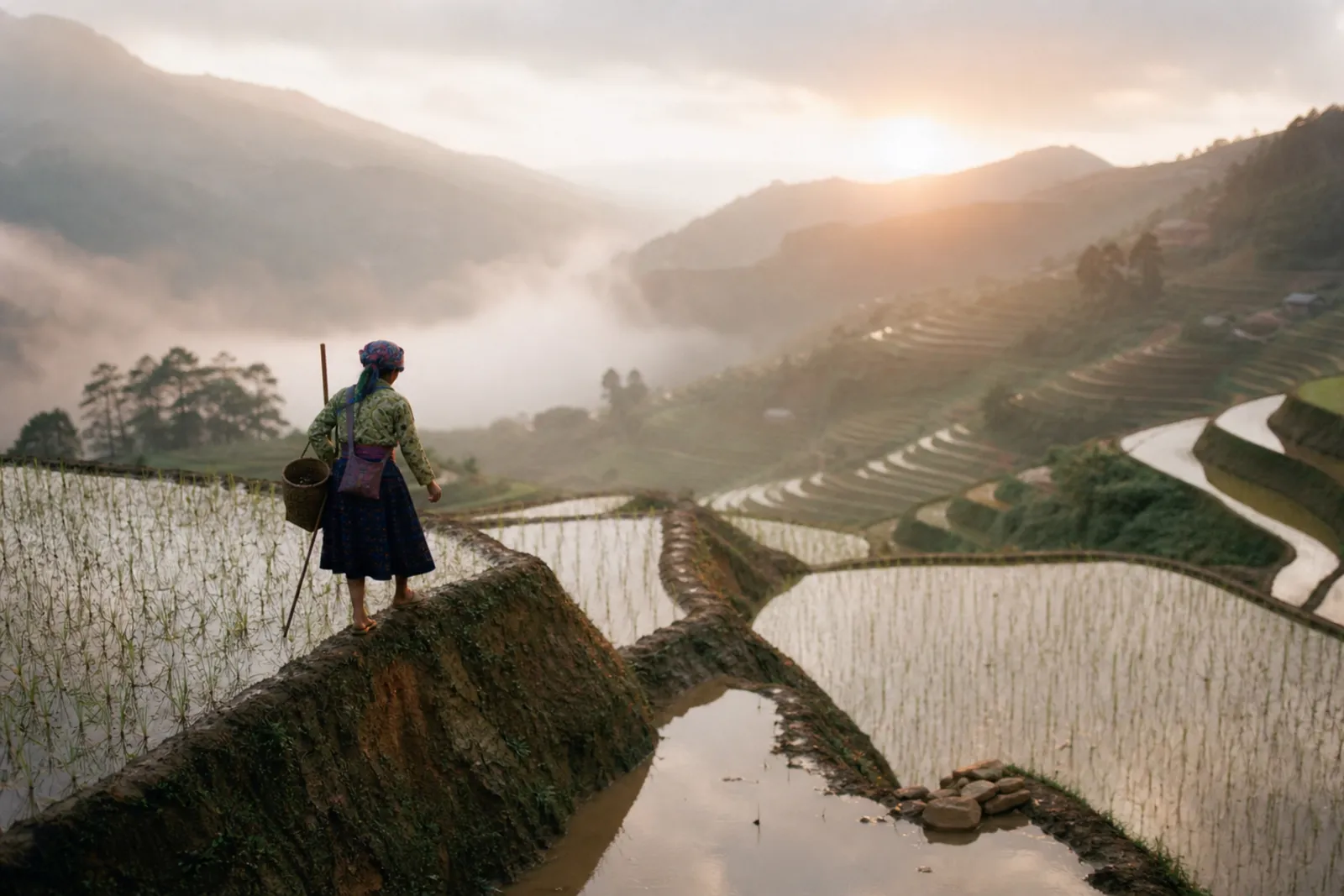
AI-generated: dawn mist over flooded rice terraces in northern Vietnam, water mirroring the skyAI image

The journey

Vietnamese Rice: From Flooded Paddy to Your Bowl

In Vietnam rice is not a side dish. It is the meal, the conversation opener and the calendar. Here is how it gets from the mud to the table.

13 min readUpdated October 27, 2026

The Journey of a Grain of Rice

From the paddy to your table. Tap a station.

  1. Seed
  2. Field
  3. Harvest
  4. Market
  5. Kitchen
  6. Table
  7. At home

Chapters

Key takeaways

  • Vietnamese rice is a family of very different grains: everyday long-grain and fragrant rice, glutinous (sticky) rice for xôi, and broken rice for cơm tấm. Each has its own cooking method.
  • The Mekong Delta grows roughly half of the country's rice and supplies over 90 % of its exports (official figures, varying by year).
  • In 2019 the Vietnamese variety ST25, bred in Sóc Trăng, won the title of World's Best Rice at a rice conference in Manila.
  • Cook ordinary rice by following your cooker or package instructions, rinse it first and let it rest after cooking. Sticky rice is soaked and steamed, not boiled.
  • You can rebuild most of the Vietnamese rice table abroad with a rice cooker, a steamer basket and the right grain from an Asian shop.

Vietnamese rice: the staple behind every meal

Vietnamese rice is easy to describe badly. People say "jasmine rice" and move on, as if the whole country ate one grain. It does not. A Vietnamese kitchen can hold half a dozen kinds of rice, and each one has a job: a plain, slightly fragrant white rice for the everyday family meal, a glutinous rice that turns into xôi and bánh chưng, a heap of broken grains for cơm tấm, rice flour for noodles and cakes, and thin translucent sheets of bánh tráng for rolls.

What unites them is attitude. Rice is the centre of the plate and everything else is there to help you eat more of it. The savoury dishes, the fish sauce, the pickles, the grilled meat: in the Vietnamese way of thinking these are the thức ăn, the things that go with the rice, not the other way round. Once you see a meal like that, the rest of Vietnamese food makes more sense.

Say it in Vietnamese

Ăn cơman kuhm · To eat (a meal). Literally: to eat rice.
Ăn cơm chưa?an kuhm chuh-uh · Have you eaten yet? A warm, common way to open a conversation.
Chén cơmchen kuhm · A bowl of rice.

Think about how a Vietnamese meal is built, because it explains why the grain matters so much. You rarely get one big plate with everything piled together. You get a bowl of plain rice, and around it a set of dishes that are deliberately stronger than the rice: a salty braise, a sour soup, a plate of bitter greens, a dip that bites. Each mouthful is a little of something loud and a lot of something quiet. The quiet part is the rice. It is the canvas, and the cook's job is to make sure the canvas is clean, fresh and soft.

This is also why Vietnamese cooks fuss about rice in a way that can look excessive from outside. They notice a bag that smells stale. They notice rice that is too wet, or too hard, or has sat too long on the warm setting. A pot of rice is not judged on its own merits as much as on whether it lets the rest of the table work.

For a visitor, the first lesson is to stop treating rice as filler. Eat it slowly, plain, with the first dish you are served. You will start to taste the grain: faintly sweet, faintly floral if it is a fragrant type, and always a little different depending on the harvest.

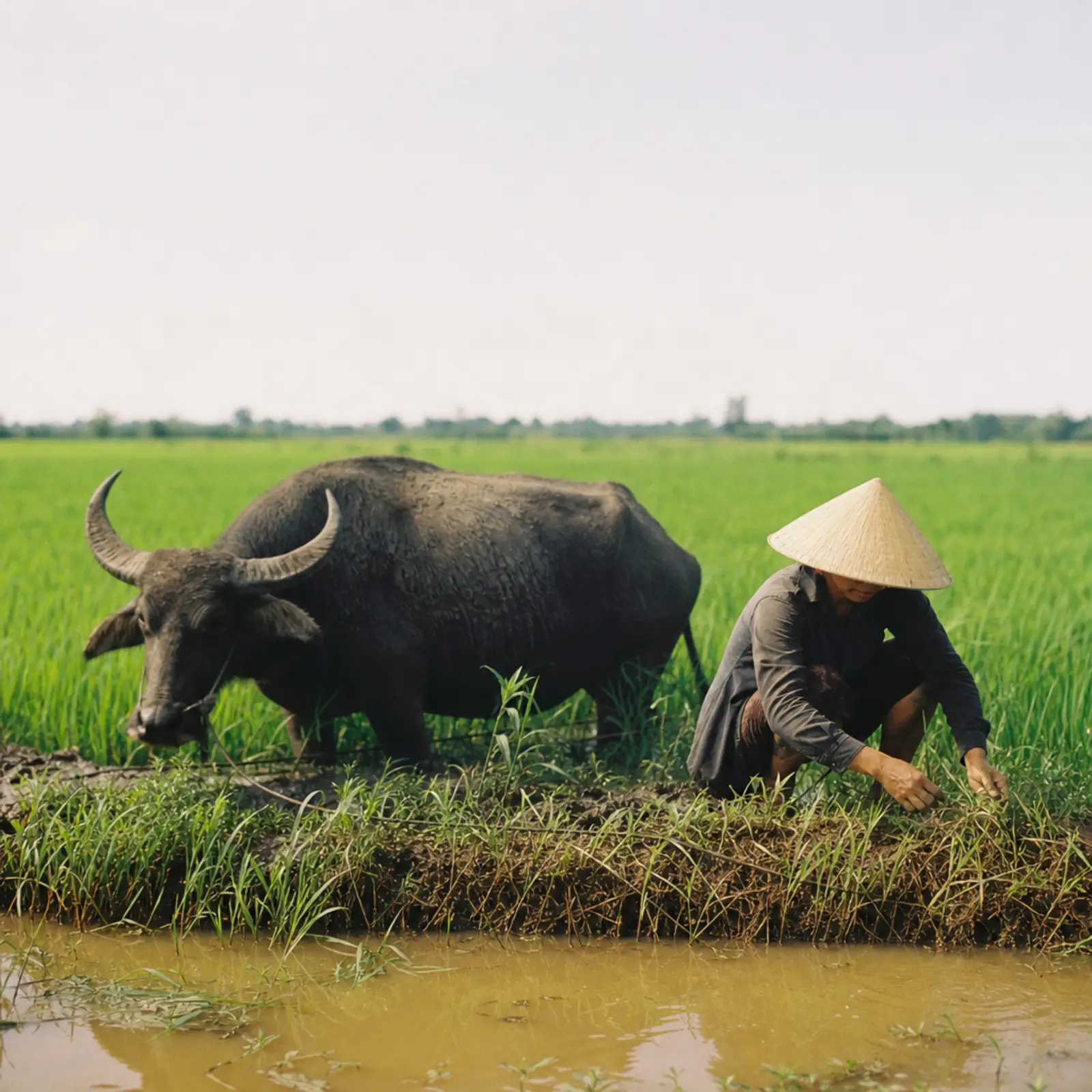
AI-generated: flat Mekong Delta rice paddies stretching to the horizon with a water buffalo and a farmer in a conical hatAI image
The Mekong Delta: flat, wet and green to the horizon.

The numbers back up the attitude. In 2025 Vietnam exported roughly 8.06 million tonnes of rice, worth about 4.1 billion US dollars. Over the first half of 2025 the country ranked second among rice exporters, behind India and ahead of Thailand. In general, Vietnam counts among the biggest rice exporters in the world, and it manages that while also feeding a population that eats rice every single day.

That double role shapes what you find in shops. A lot of export rice is graded, milled and sorted for buyers who want consistency. The rice Vietnamese families cook at home is often a different, more local story, bought from a trusted seller and chosen for smell and texture rather than for a certificate.

Vietnam is a long country, and rice looks different along its length. In the south, the Mekong Delta is flat, wet and enormous, with fields stretching to the horizon and canals acting as roads. In the north, the land folds into mountains, and farmers have cut terraces into the slopes so that water can stand in steps. Between them lie coastal plains and river valleys where rice has been grown for a very long time.

What stays constant is the dependence on water. A Vietnamese farmer is, in practice, a water manager who also grows rice. Floods can bring silt and life; a storm at the wrong moment can flatten a crop; a dry spell or salt water creeping inland can wreck a season. If you want the detail, our guide to rice farming in the Mekong Delta follows the crop from seedling to harvest.

rice exported by Vietnam in 2025
~8.06 Mt
rice exported by Vietnam in 2025
export value in 2025
~4.1 bn USD
export value in 2025
of national rice output from the Mekong Delta (official figures, varies by year)
~50 %
of national rice output from the Mekong Delta (official figures, varies by year)
of exports from the Mekong Delta (official figures, varies by year)
90 %+
of exports from the Mekong Delta (official figures, varies by year)
12
  • 1. Mekong Delta

    The rice basket. Flat land, canals, buffalo and usually two to three harvests a year, depending on dike protection. Read the full story in our farming guide.

  • 2. Mù Cang Chải

    Terraced fields carved into northern mountainsides. Smaller in volume, famous for the view and for the labour behind every step of the slope.

From paddy to market: how the grain is made

Every bowl starts as paddy, rice still wrapped in its husk. In the south it grows in wide, flat, flooded fields; in the north farmers shape water into terraces on the slopes. Seedlings are planted into wet soil, the field stays flooded for much of the season, and the whole system depends on water arriving at the right time and in the right amount.

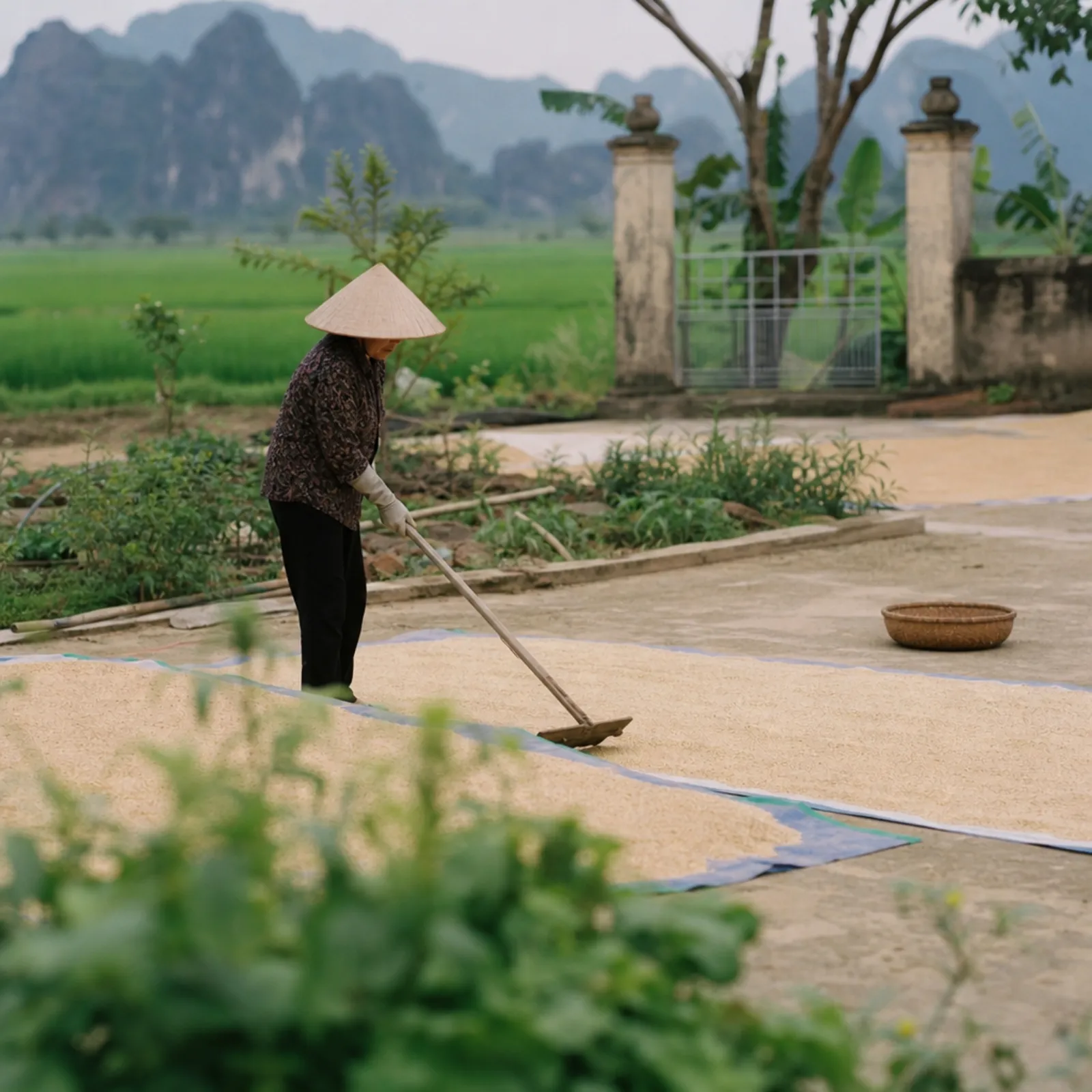
Then comes the harvest. In many places it is still hands, sickles and bundles; elsewhere machines do the cutting. Either way the freshly cut paddy is wet and has to be dried quickly, or it spoils. That is why you see rice spread on tarps in yards and along village roads, raked by people in conical hats. Drying is not a romantic detail. It decides how well the grain keeps and how it cooks.

AI-generated: harvested rice spread to dry on tarps in a yard, a person in a conical hat raking the grainAI image
Drying yard: the unglamorous step that decides how the rice will cook.

Between the mill and your bowl sits the market, and this is where a lot of the character of Vietnamese rice shows. In a traditional market the rice seller sits behind open sacks, each with a different grain. Shoppers scoop a handful, rub it between their fingers, smell it, and ask questions. Is this the new harvest? Is it soft or firm when cooked? Is it for everyday meals or for guests? The seller answers, the scoop goes into a bag, and the sale is a small conversation.

That habit is worth remembering when you shop abroad. You may not be able to open the sack, but you can still read the bag, look at the grain through the window, and ask the grocer which rice sells fastest. People who run Asian shops tend to know exactly which bags their customers come back for.

Rice also leaves the market in other forms. Some is steamed into thin sheets and dried, which is bánh tráng. Some is ground into flour for cakes and noodles. Some is fermented. The grain is a raw material for half the kitchen.

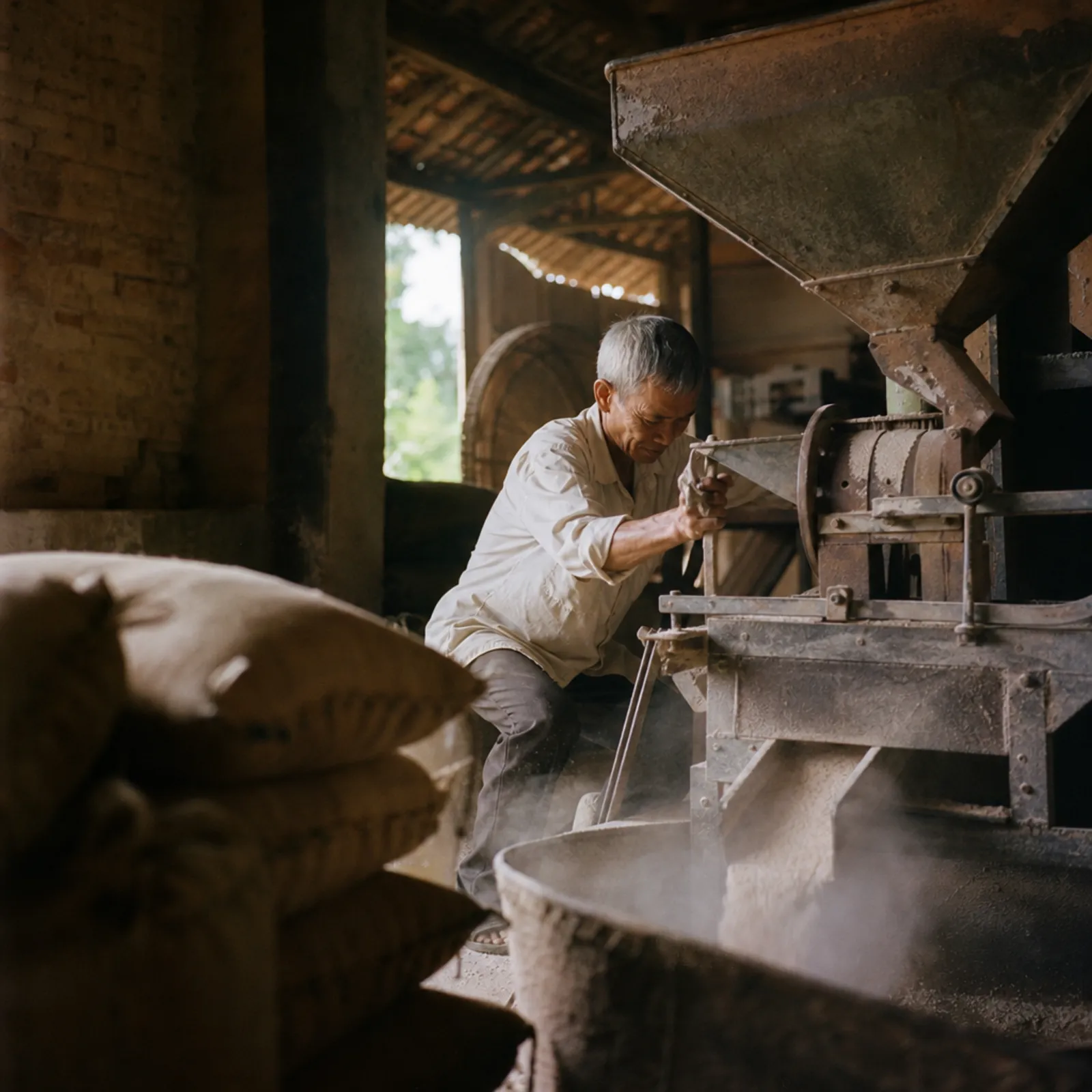
After drying, the paddy goes to the mill. The husk comes off first, giving brown rice. Further milling removes the bran and leaves white rice. Along the way, some grains break. That is not a failure: broken grains are sorted out and sold on, and cooks in the south built an entire dish on them, cơm tấm, now a landmark of Sài Gòn cooking. We cover that in the cơm tấm recipe.

The full story of the field, from seedling to Mekong flood and salt water creeping inland, lives in our guide to rice farming in the Mekong Delta. If you only remember one thing, remember this: rice in Vietnam is a water crop, and almost everything about the landscape, the calendar and the cooking follows from that.

AI-generated: an old rice mill with sacks of rice and dust drifting in a shaft of lightAI image
At the mill the husk comes off. Keep it on and you have brown rice; mill further and you have white.

Say it in Vietnamese

Gạo lứtgow luht · Brown rice.
Gạo tấmgow tuhm · Broken rice grains.

The kinds of Vietnamese rice you actually meet

Here is the short map. Our full guide to Vietnamese rice varieties goes much deeper, but this is enough to shop and cook sensibly.

Everyday and fragrant rice. Long, slim grains that cook up separate and soft with a gentle aroma. This is the rice for the family bowl, for fried rice the next day, and for porridge. Names on bags vary a lot, and the word "jasmine" is used loosely, so look at the grain and smell the bag rather than trusting the label alone.

Glutinous (sticky) rice, gạo nếp. Short, plump, opaque grains that fuse when steamed. Despite the name there is no gluten in it; "glutinous" refers to the sticky texture. It becomes xôi, the filling in bánh chưng and countless sweets. It wants soaking and steaming. See the sticky rice and xôi recipe.

Broken rice, gạo tấm. Not a separate variety but grains that broke during milling. They cook faster and soak up flavour, which suits cơm tấm.

ST25. A fragrant variety bred by Hồ Quang Cua and his team in Sóc Trăng, in the Mekong Delta. In 2019 it won the title of World's Best Rice at a rice conference in Manila. It is a fine rice, and also a name that gets stuck on bags it does not belong on, so buy from a source you trust.
A word about names, because they cause confusion at the shop. "Jasmine" is a style, not a guarantee of origin or variety. "Sticky rice" and "glutinous rice" and "sweet rice" are three names for one thing. "Broken rice" is not a premium product and not a defective one: it is a by-product that happens to be perfect for one dish. And "Vietnamese rice" on a bag can mean anything from a carefully bred fragrant variety to a plain commodity grain, which is not a criticism, just a reminder that the label is a starting point.

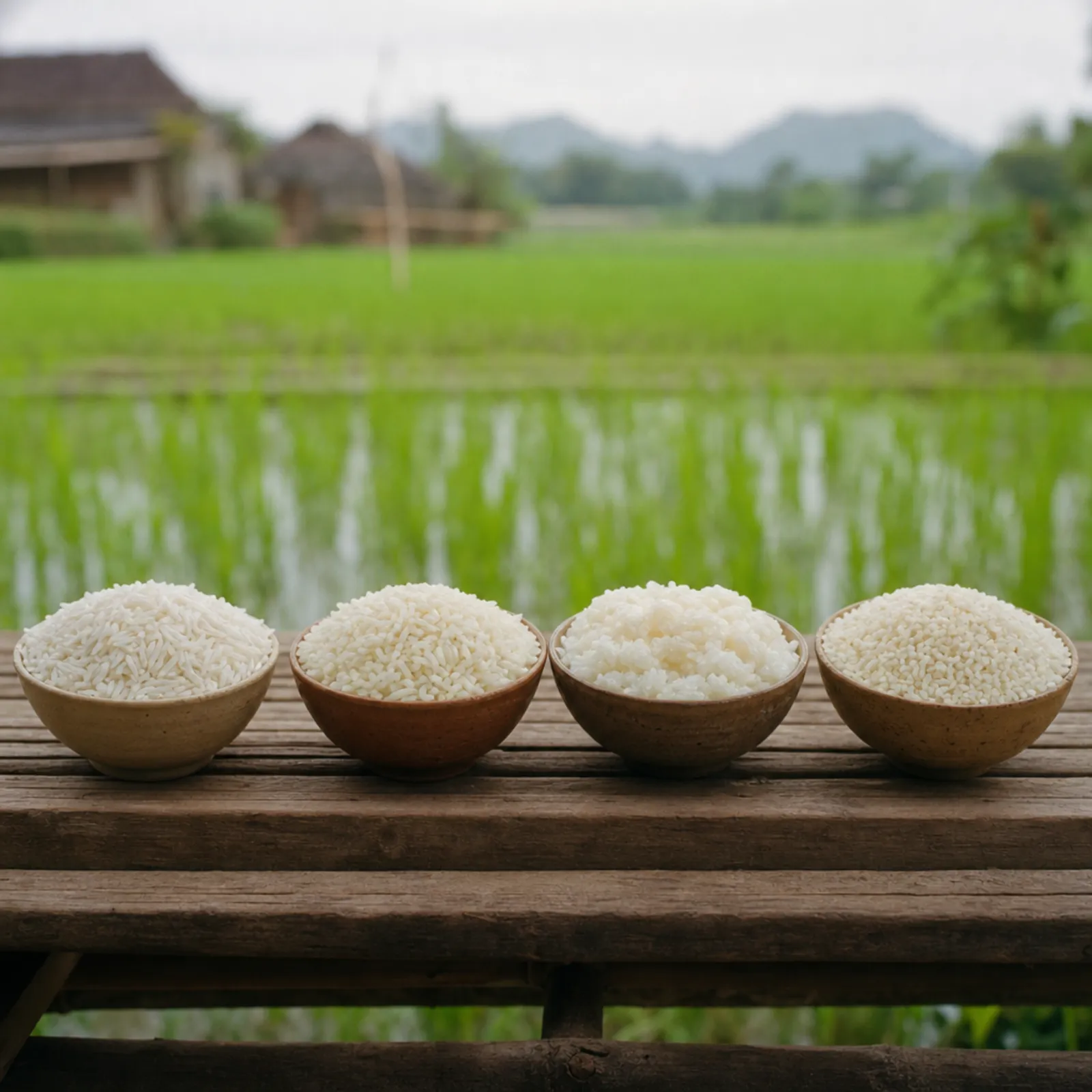
The grain shape tells you more than the name. Long and slim grains cook up separate. Short and round grains cling together. Short, plump and chalky-white grains are glutinous. Broken pieces, whatever the shape of the original grain, cook fast and soft. Learn to read those four signals and you can shop confidently in any language.

AI-generated: four bowls on a table holding long-grain, fragrant, sticky and broken rice, no brand namesAI image
Four grains, four jobs.

Say it in Vietnamese

Gạo nếpgow nep · Glutinous (sticky) rice.
Xôisoy · Sticky rice, steamed, sweet or savoury.
Cơm tấmkuhm tuhm · Broken-rice plate, a Sài Gòn classic.
Cháochow · Rice porridge.
Cơm chiênkuhm chee-en · Fried rice.

Rice does not stop at the grain. It is ground to flour, steamed into thin sheets, and cut into noodles. Our rice paper guide covers bánh tráng, bún and phở noodles, and what to look for when you buy them.

Where does that leave the famous names? ST25 is the one you will hear most often. It is a fragrant variety bred in Sóc Trăng by Hồ Quang Cua and his team, and its 2019 title as World's Best Rice made it a national symbol. It is a good story and, by all accounts, a good rice. But the name's fame also invites copies, so buy from a source you trust and do not assume that a big claim on a bag proves anything. Our guide to rice varieties explains how to read a bag and what to look for.

Say it in Vietnamese

Bánh trángbahn chahng · Rice paper.
Búnboon · Thin round rice vermicelli.
Phởfuh · Flat rice noodles, and the soup built on them.

Rice at the table: more than food

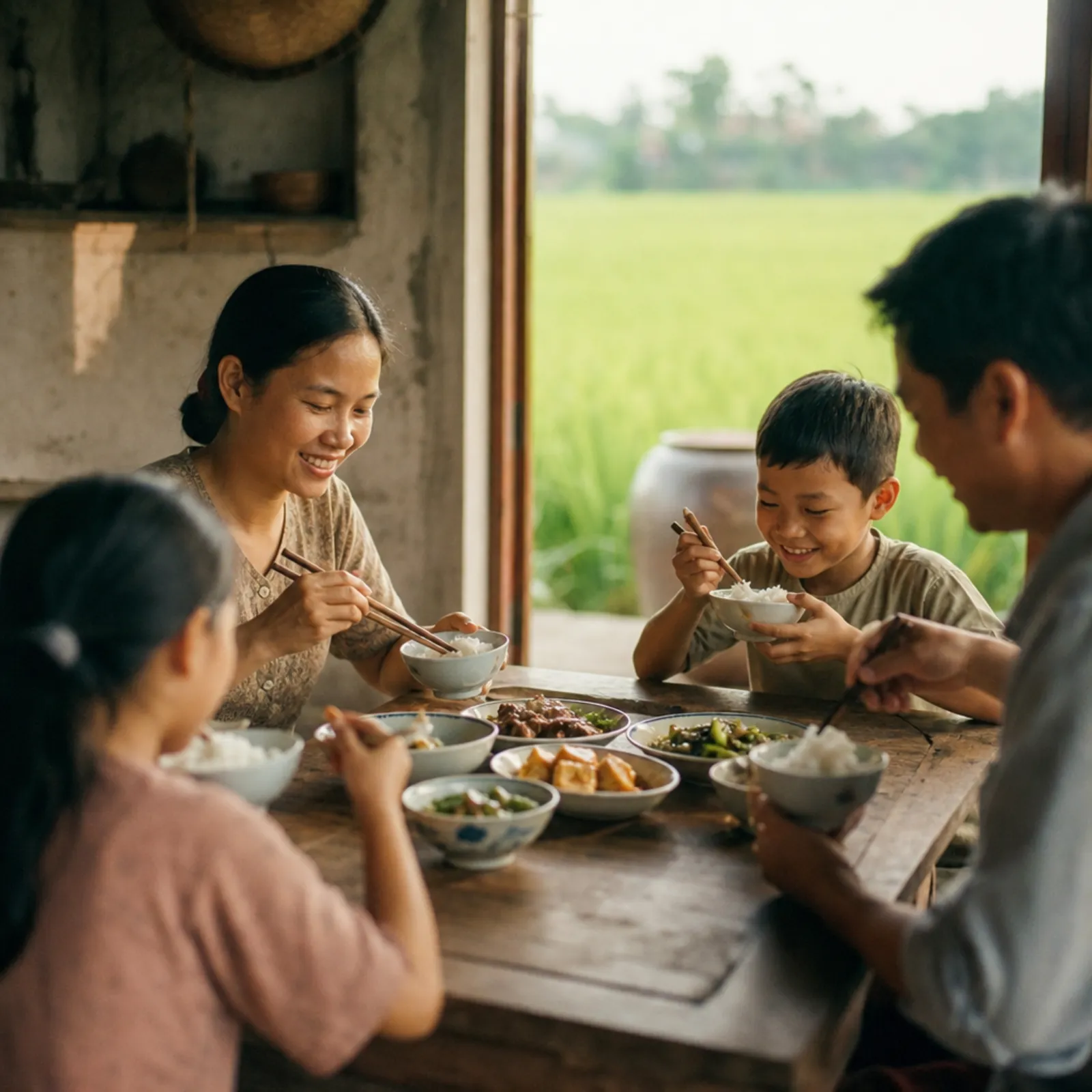
Walk into a Vietnamese home at mealtime and the structure is clear. A pot of rice sits in the middle or near the host. Each person has a small bowl. Shared dishes, soup, a plate of vegetables, a dip of fish sauce, come and go around it. You fill your own bowl, eat from it, refill when it is empty. The bowl never leaves your hand for long.

It is also a language. Asking ăn cơm chưa?, "have you eaten yet?", is a common way to start a conversation, and it carries real care: are you looked after, are you well. There are rules, some of them strict. In general, you do not stand your chopsticks upright in a rice bowl, and the eldest at the table is invited to start. Our guide to rice culture and Tết goes into the manners, the proverbs and the New Year rice cakes.

Watch how people actually eat. The bowl is held in the left hand, close to the chin. Chopsticks move rice to the mouth, or a spoon does for softer dishes. Shared dishes stay in the middle, and you reach for a piece with your own chopsticks or with serving ones if the family uses them. Someone notices when a bowl is nearly empty and refills it. Nobody is expected to finish a mountain on one plate and be done.

There is a quiet generosity built in. Elders or guests may find a good piece of fish placed in their bowl. A child gets the soft part of the dish. These are not formal rules so much as habits of attention, and the rice bowl is the stage on which they play out. If you want to go deeper into the manners and the New Year rice cakes, our rice culture and Tết guide is the place.

AI-generated: a family eating from small rice bowls with chopsticks around shared dishes in warm lightAI image
The bowl in your hand, the shared dishes in the middle.

Say it in Vietnamese

Đũadua (rising) · Chopsticks.
Bánh chưngbahn chuhng · Square sticky rice cake wrapped in leaves, a Tết staple.
Tếttet · Vietnamese New Year.

Quick quiz: Which dish is traditionally made from broken rice?

How to cook Vietnamese rice, the plain version

Ordinary white rice is the foundation, and most mistakes happen here. The method below works in a pot or a rice cooker. It deliberately avoids hard numbers for time and water, because grains differ by variety and by age. Follow your cooker or package instructions for the water ratio and the cooking time. As a general anchor, a ratio in the region of one part rice to somewhat more than one part water is common for everyday rice, and cooker manuals are usually the most reliable guide.

A few notes before the steps. Rinsing matters because loose starch on the surface of the grains makes the finished rice gummy; a few changes of cool water get rid of most of it. Do not scrub, especially with broken rice, which is fragile. Measure with the same cup every time, so that you can adjust by small amounts and learn how your rice behaves. And treat the first batch from a new bag as a test: some bags want a touch more water, some a touch less, and the harvest year changes things too.

If you use a rice cooker, the measuring lines inside the pot are your friend. They are calibrated for the machine, and they are more reliable than any ratio you read on a website, including this one.

How to cook Vietnamese white rice

Total time: 30 min

  1. Measure and rinse

    Measure the rice. Rinse it in cool water, swirling with your hand, until the water is much less cloudy. Drain well.

  2. Add water

    Add water according to your cooker or package instructions. Level the rice so it cooks evenly.

  3. Cook

    Use the white-rice programme on a cooker, or bring a covered pot to a simmer, then turn the heat low and leave the lid on. Check the package for timing.

  4. Rest

    When the cooker clicks off or the pot is done, leave the lid closed for a while. The steam finishes the grains.

  5. Fluff and serve

    Loosen the rice gently with a paddle or a fork, from the edges to the middle. Serve warm in small bowls.

Fried rice, cơm chiên, is the best proof that cooking rice well matters even when you plan to cook it twice. Day-old rice that has been kept cool and covered fries into separate, lightly toasted grains; freshly cooked rice that is still wet clumps in the pan. The same logic applies to porridge: leftover rice simmered with extra water becomes cháo, a comfort food for cold mornings and sick days. Nothing is wasted, which is exactly how the Vietnamese kitchen likes it.

Sticky rice is a different method entirely. It is soaked and then steamed in a basket, never boiled in a pile of water. The details are in our xôi recipe. And if you cook rice often, a decent cooker pays for its counter space quickly: see our rice cooker buying guide for what actually matters.

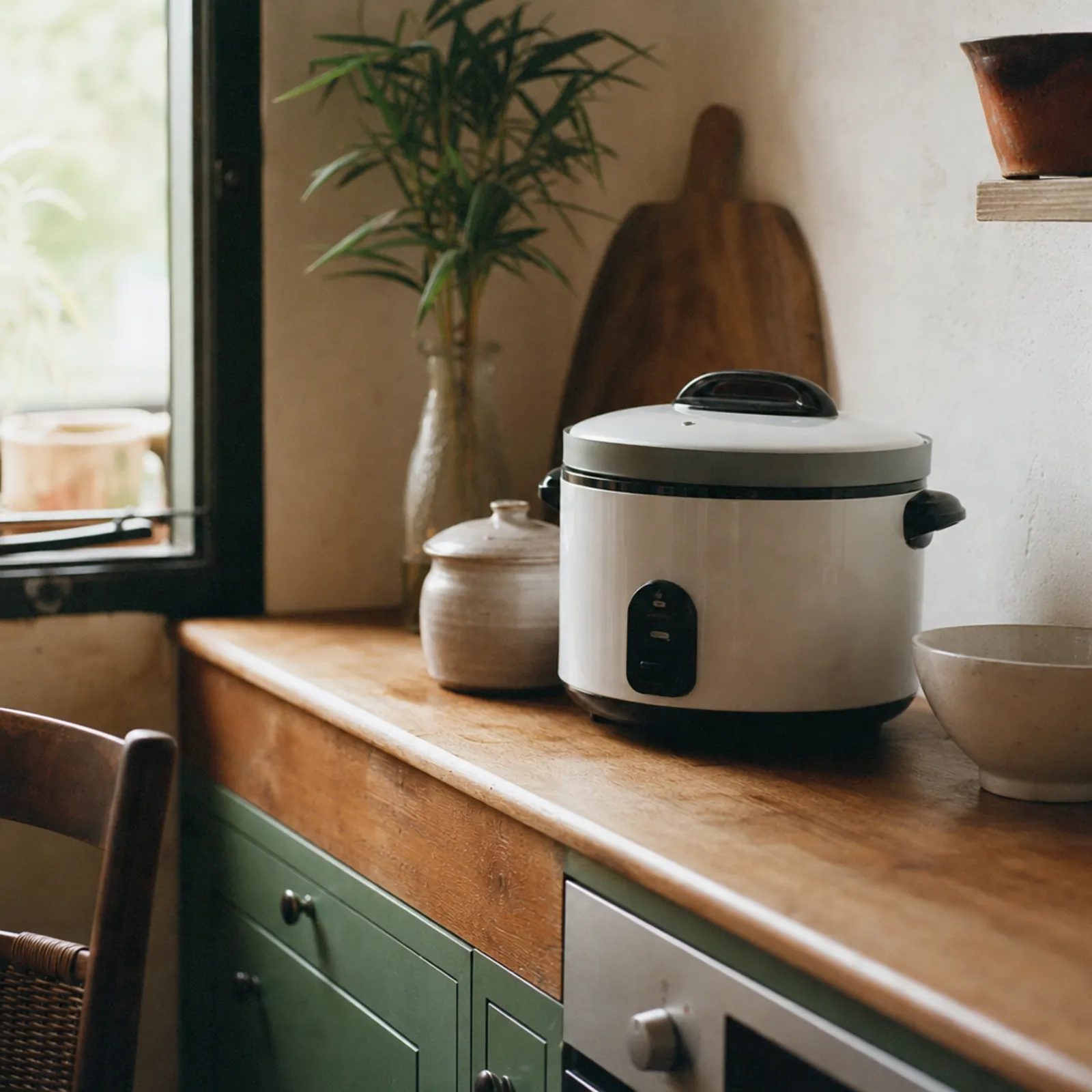
AI-generated: a rice cooker on a kitchen counter in morning light, no logoAI image
A rice cooker earns its place if you eat rice more than occasionally.

Bringing Vietnamese rice home

You do not need a Vietnamese kitchen to cook Vietnamese rice. You need the right grain for the dish, a reliable way of cooking it, and a few bowls that feel right in your hand.

Start with the grain. For everyday meals, a fragrant long-grain rice from an Asian grocer is a good starting point. For xôi, buy glutinous rice, and make sure the bag says so. For cơm tấm, look for broken rice; a bag of long-grain broken rice is the right idea, and a bag of broken basmati is the wrong one. Then match the tool: a cooker for plain rice, a steamer basket for sticky rice.

Everything is covered in Vietnamese rice at home, including a section for Vietnamese families abroad who want to rebuild the dishes they grew up with. If you are buying, our guide to rice varieties tells you how to read a bag.

A final thought on what to cook first. If you are new to Vietnamese rice, begin with the plain bowl and one strong dish next to it. A grilled or braised dish with a sharp dipping sauce teaches you the structure of the meal in a single sitting. Then move to cơm tấm, which turns the by-product of the mill into a plate worth queuing for. After that, try xôi and feel the different logic of steaming. Each recipe in this guide builds on the one before it.

Starting kit for a Vietnamese rice table

This page contains affiliate links. As an Amazon Associate we earn from qualifying purchases. The price for you stays the same.

Our pick

Duftreis Jasmin (5 kg)

A fragrant long-grain rice is the most useful bag to own. It covers daily meals, fried rice and porridge.

Pros
  • Works for most everyday dishes
  • Pleasant aroma without being heavy
  • Easy to cook in any cooker or pot
Cons
  • Quality varies a lot between bags, so check the grain and the harvest information
  • Labels are not always precise about origin
View on Amazon
Budget pick

Reiskocher klein (1–1,8 l)

A small, simple cooker handles plain rice with little effort and little counter space.

Pros
  • Compact
  • Reliable for everyday rice
  • Easy to clean
Cons
  • Fewer programmes
  • Small batches only
View on Amazon
For purists

Reisschale Keramik

Small ceramic bowls change how a meal feels. The Vietnamese way is a bowl you hold in one hand.

Pros
  • Right size for a single serving
  • Retain heat
  • Pleasant to hold
Cons
  • Can chip
  • Not a performance upgrade, only a ritual one
View on Amazon

Frequently asked questions

What type of rice do Vietnamese people eat?

Mostly everyday white rice, often a fragrant long-grain type, cooked plain and eaten with shared dishes. Glutinous rice (gạo nếp) is eaten as xôi and in rice cakes, and broken rice (gạo tấm) is the base of cơm tấm.

Is Vietnamese rice the same as jasmine rice?

Not exactly. Vietnam grows many varieties, and "jasmine" on a bag is often a loose description of a fragrant long-grain rice. Check the grain and the aroma rather than relying on the word alone.

What is ST25 rice?

ST25 is a fragrant Vietnamese variety bred in Sóc Trăng in the Mekong Delta by Hồ Quang Cua and his team. It won the title of World's Best Rice in 2019 at a rice conference in Manila.

What is broken rice (cơm tấm) and why is it used?

Broken rice is made of grains that broke during milling. It is not a separate variety. It cooks quickly and soaks up sauces well, which is why it became the base of the plate cơm tấm, today a landmark of Sài Gòn cooking.

What is the rice-to-water ratio for rice in a rice cooker?

It depends on the grain and the cooker. Follow your cooker or package instructions. Many cookers have measuring lines inside the pot for exactly this reason.

How do you cook sticky rice without a steamer?

Soak it first, then you can improvise a steamer with a colander over a pot with a lid, lined with a cloth. Our xôi recipe shows the method in detail.

What is the difference between glutinous rice and sticky rice?

They are the same thing. "Glutinous" describes the sticky texture; the rice contains no gluten. In Vietnamese it is gạo nếp.

How much of Vietnam's rice comes from the Mekong Delta?

According to official figures, roughly half of national rice production and over 90 % of rice exports come from the Mekong Delta. The exact share varies from year to year.

Continue the journey

Keep exploring

As an Amazon Associate we earn from qualifying purchases.